
Today, people constantly use AI search when looking for information or making purchase decisions. It has become far easier for many to ask ChatGPT or read a quick AI Overview instead of scrolling through dozens of links on Google.
Recent statistics from Semrush prove it: among over 1,000 U.S. consumers, 85% now use AI-powered search tools at least weekly for research. More importantly, 50% have purchased a product after searching with AI tools.
So, it’s safe to say that AI search visibility is becoming a natural part of the buyer journey. That’s why it’s important not only for brand discovery but also for lead generation.
In this article, we’ll understand why AI search optimization is a must for your brand to become more visible and get more conversion-ready prospects.
Why AI search visibility matters for businesses
High-intent traffic
Many blame AI tools and features for “stealing” their traffic. While it’s true that most businesses see web traffic decline, the clicks that come from AI tools are often much more high-intent. That’s why they have much more lead generation potential.
In fact, Adobe Digital Insights’ Q3 2026 AI Traffic Trends Report analyzed over one trillion visits to U.S. retail sites. And these were their findings:
- Shoppers referred by AI search traffic convert at a rate 54% higher than non-AI traffic.
- They also generate 53% more revenue per visit and spend 15% more time on site.
How does this happen?
AI often includes brand mentions and AI citations when responding to user queries. And people usually trust AI enough to click on these links. According to Semrush’s buyer journey study, 94% of users click links included in AI responses at least sometimes, and 38% do so often or almost always. Only 3% say they never click.
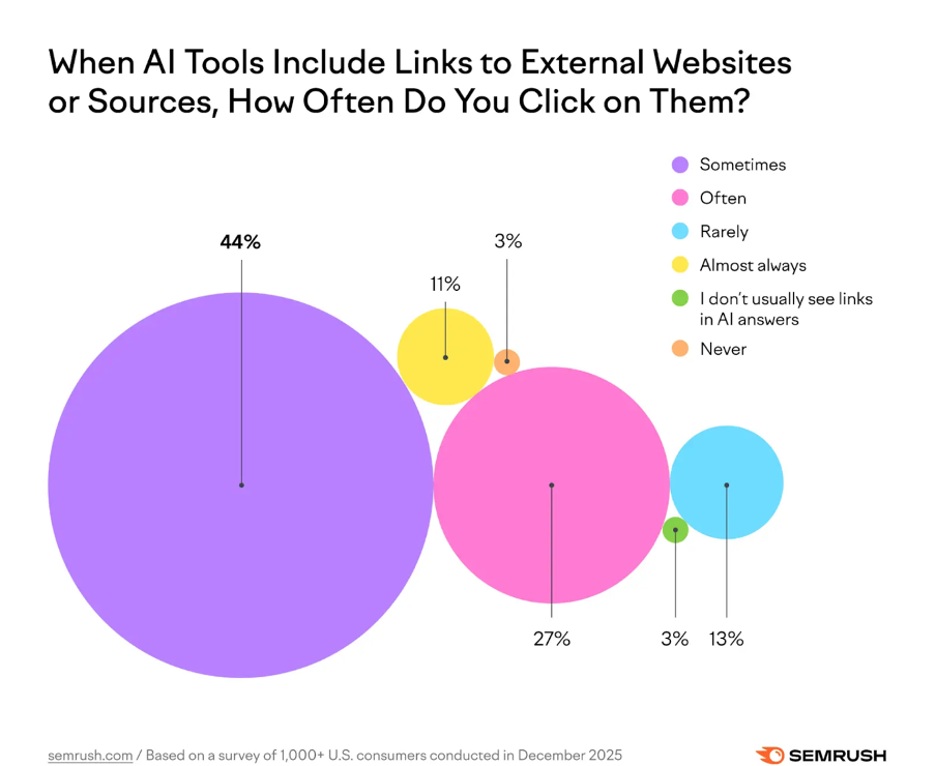
Source: Semrush
So if your brand earns an AI citation, there is a very real chance that it can turn into a website visit and then a conversion. This is how AI-driven lead generation works in practice.
AI systems often rely on signals associated with entity authority. That includes consistent brand mentions, authoritative content, trust signals, references across reputable sources, and credible backlinks. That’s why Generative Engine Optimization (GEO) is about being mentioned across the web, not just on your own website.
Working with a reliable link-building company is one of the most practical steps you can take to get more backlinks and mentions and improve your AI search visibility.
Low competition opportunity
AI discoverability is still in its early stages. So many companies have not started exploring it yet. Most mainly rely on traditional SEO alone to become more visible to potential consumers. While SEO strategies are still a great way to generate leads, AEO and GEO are becoming just as important. All this creates a real opportunity.
Brands that begin building LLM visibility now may gain an advantage as AI-driven discovery continues to grow. It is very similar to how organic search started. The businesses that moved first built strong authority, making it much harder for competitors to catch up later. Now, there is a similar situation with AI optimization.
The great thing about GEO or AEO (whatever you call it) is that you do not have to start from zero. This optimization strategy is built directly on an SEO foundation.
If you have already done solid SEO work, you are much closer to good AI visibility than you think. For many brands, it’s enough to simply adjust some of the tactics based on AI search ranking factors. And even these simple tweaks can help you get quoted by ChatGPT and other AI tools.
More exposure and increased brand trust
When your brand consistently gets mentioned by AI tools, many buyers start to treat it as a more credible one, even if they haven’t visited your website yet. It’s pure psychology: repeated exposure strengthens digital reputation and builds trust.
Think about how word-of-mouth works. When your friend recommends a product, you trust them more than any ad. AI citations work similarly. According to Yext, 62% of consumers now trust AI for brand decisions.
Even if you are a new business and almost no one knows about you yet, it is still a perfect time to start. Among over 1,000 U.S. consumers, 43% of buyers have discovered a new brand through AI without running a traditional search. This means that AI discoverability is becoming an important component of demand capture strategies.
Why do people prefer AI Search?
Help at every stage of the journey.
To understand how to sell products or services with AI, you first need to understand how buyers actually use it. Some people use AI search during their entire journey, from figuring out what they need to asking for a link where they can buy it. Others use AI only at specific stages, such as comparing brands or checking prices.
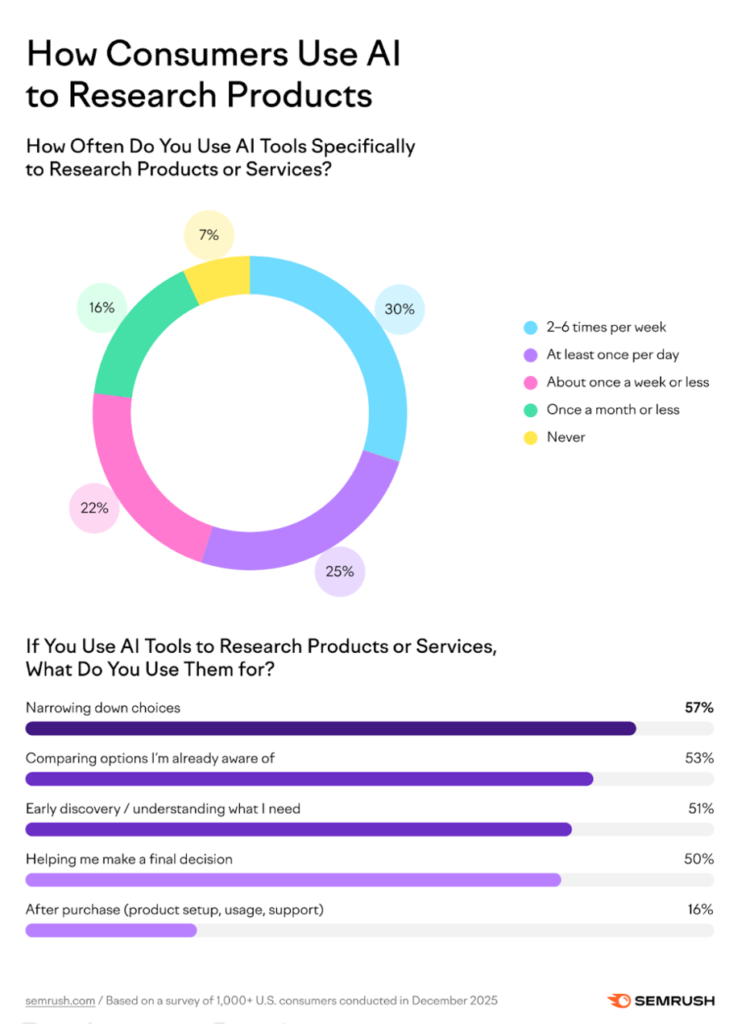
To get a clearer picture of people’s behavior, take a look at the latest survey from Semrush on how consumers use AI to research products.
Source: Semrush
From the research, we can tell that AI has become a mainstream tool in product research, with only 7% reporting that they do not use AI during decision-making. Around 50% or more use AI tools across different stages. This means your brand needs to be visible in AI search results at every step. The more consistently you show up, the higher your chances of turning those AI searches into actual leads.
Direct answers
Traditional Google search often requires users to open multiple tabs, scan through websites, compare options across different pages, etc. It takes a lot of time, and most buyers don’t really like doing that now, especially since there is a much easier and faster way.
By using AI, buyers can get a direct answer to the question they asked. It’s an absolutely different experience.
Better customer experience and personalization
One big reason people turn to AI search more and more is its power to give personalized answers. AI changes its reply based on the user’s exact situation and what they like.
People can just say anything they want and what matters most to them. For example, their budget, needs, location, etc. All this information helps AI give useful answers right away.
For instance, instead of searching for “best running shoes” and reading lots of reviews or articles, a buyer can ask AI for exactly what they need. They might say: “Good running shoes for a beginner runner, under $90 in LA.” That will be much more helpful than going through many websites and lists.
Besides, even if AI didn’t answer the query right away, shoppers can simply ask again in the same chat. They don’t need to start a new search every time.
Easier visual search
Visual search is another way people like to use AI. Shoppers can easily upload a photo and ask AI to find a similar product.
For example, a shopper might upload a picture of a backpack they like and ask for something that looks like it within a certain budget. And someone remodeling their kitchen can upload a photo and get ideas for tables or chairs that match the style.
Because of this, brands should optimize more than just written content. Clear image filenames, descriptive alt text, relevant surrounding content, and structured data can all help AI better understand and reference visual content.
Personal shopping assistant
AI search is no longer limited to answering questions. Tools such as ChatGPT now include shopping features that help users discover and evaluate products within a single conversation.
A shopper can describe exactly what they need, set a budget, compare alternatives, and receive personalized recommendations without opening dozens of tabs. And that works much better than regular conversation in an AI tool.
For example, ChatGPT Shopping Assistant can display product details, reviews, images, and direct links to retailers, making the path from research to purchase much shorter.
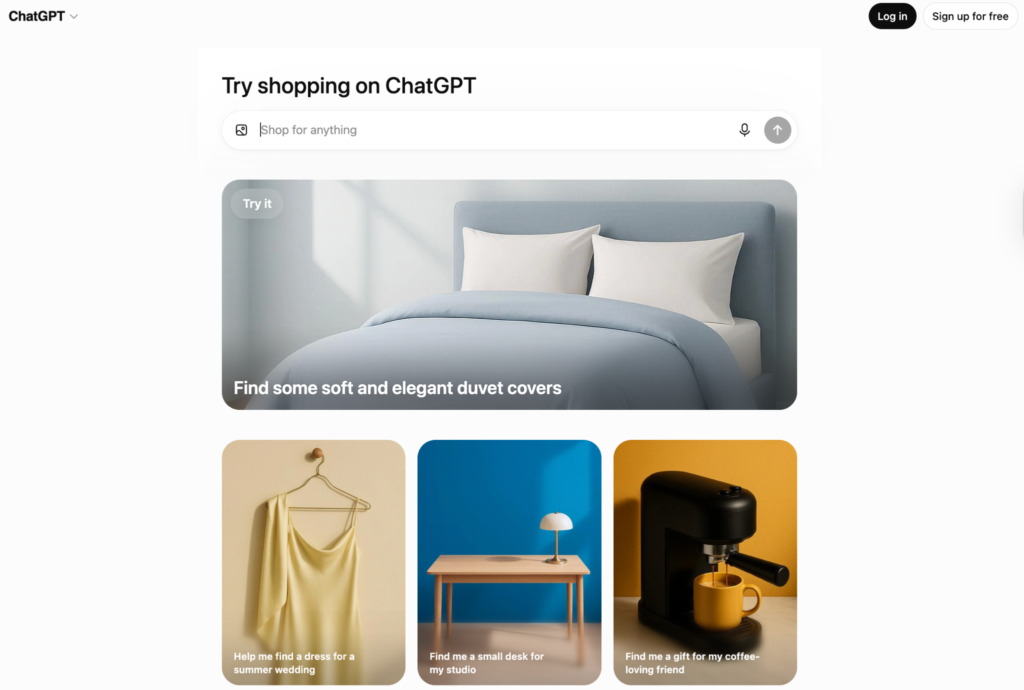
Screenshot from ChatGPT
As AI shopping assistants are becoming a more common part of the buying process, brands that appear in these recommendations may gain truly valuable exposure. And by showing up when consumers are actively evaluating products, you get more leads by default.
That’s why being visible in AI search isn’t just an option anymore. It’s an important goal for every business.
Conclusion
Improving AI search visibility can sound like a real challenge, but in fact, it is also a huge opportunity. AI is not just a current trend. It is rapidly becoming a core part of how people discover, research, and choose brands.
Of course, it takes time to become visible in AI search because you need to build the signals AI relies on. But you will find it worthwhile when you start getting AI citations and high-intent leads. Because those citations put your brand in front of buyers who already know what they want, not those who are still figuring it out.
The good news is that you do not need to start from scratch. If you already have solid SEO foundations, you are much more likely to win in AI search. And if you don’t know where to begin, just book a free call, and our team will help you with targeted lead generation through multiple channels.